
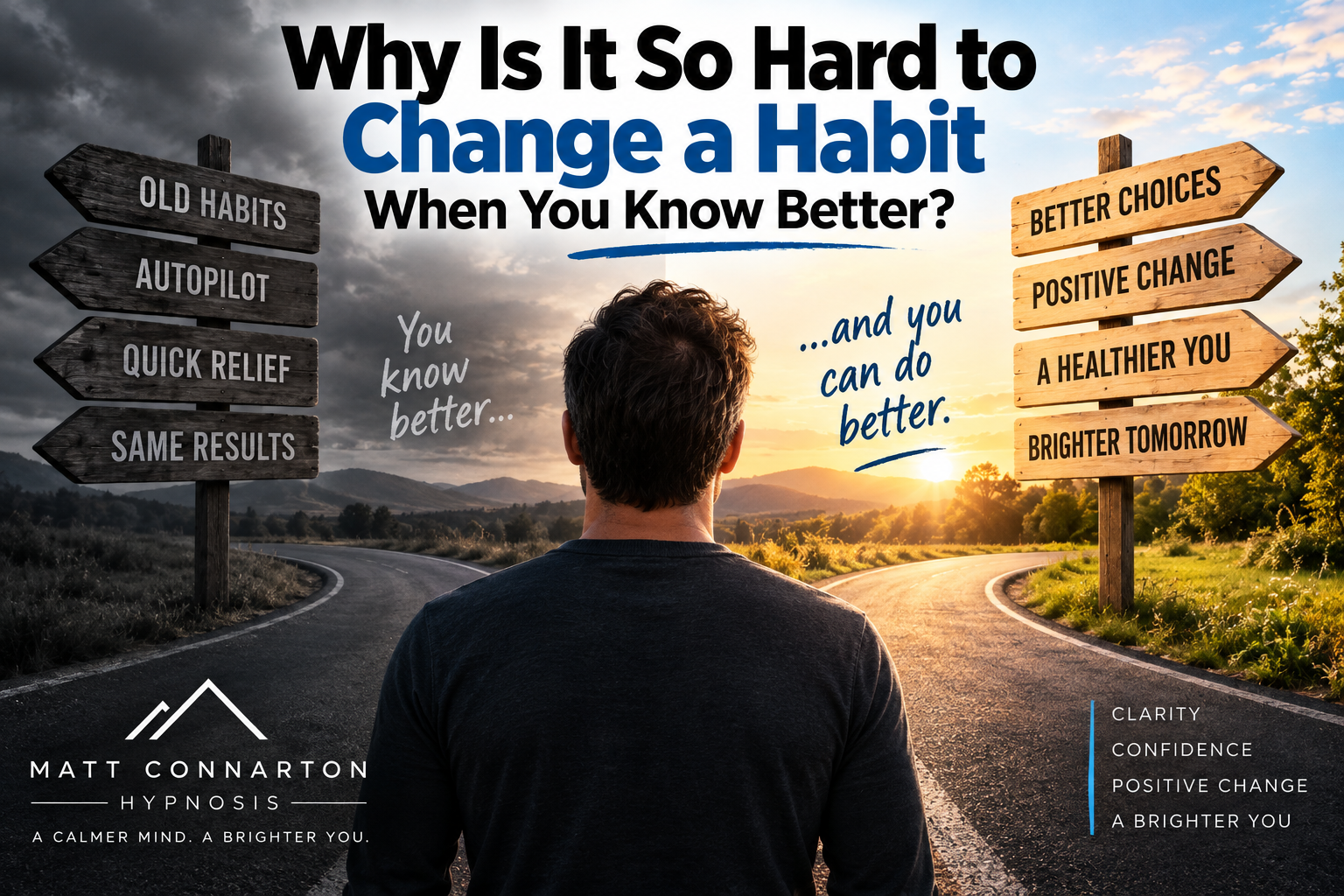
Have you ever caught yourself doing something you had already decided you weren’t going to do?
Maybe you procrastinated even though you knew it would create more stress later.
Maybe you fell back into an unwanted habit after promising yourself that this time would be different.
Maybe you knew there was absolutely no reason to be nervous about something — and felt nervous anyway.
It can be incredibly frustrating.
After all, if you understand the problem, shouldn’t you be able to simply stop doing it?
Not necessarily.
We can consciously understand that a behavior, thought, or emotional response isn’t helping us and still find ourselves repeating it. That’s because many of our responses become learned and automatic over time.
Your Conscious Decision Is Only the Beginning
Imagine deciding that you’re going to stop procrastinating.
That decision may be completely sincere.
Then tomorrow arrives.
You sit down to begin something you’ve been avoiding, feel uncomfortable, and suddenly checking your phone seems like a fantastic idea.
Twenty minutes later, you’re doing exactly what you promised yourself you wouldn’t do.
What happened?
Your conscious intention ran into an established pattern.
We often assume that making a decision should automatically change our behavior. But behaviors that have been repeated many times can become remarkably easy to perform without much deliberate thought.
That efficiency is usually helpful. You wouldn’t want to consciously relearn how to brush your teeth every morning.
But the same ability to automate behavior can also preserve patterns we would rather change.
The Familiar Can Feel Easier Than the Better Choice
Human beings become accustomed to repetition.
If you’ve responded to a certain situation the same way hundreds of times, that response has something important working in its favor:
It’s familiar.
The new behavior may be objectively better for you, but it hasn’t had the same amount of practice yet.
Think about learning to drive.
At first, you had to consciously think about practically everything. Eventually, many of those actions became automatic.
Changing a long-standing habit can sometimes feel like reversing that process.
You’re asking yourself to interrupt something familiar and deliberately practice something different.
Instead of asking only, “How do I stop the old habit?” ask, “What response do I want to practice until that becomes familiar?”
Why Telling Yourself “Don’t Do It” Can Backfire
There’s another trap people often encounter when trying to change.
They spend enormous amounts of mental energy thinking about the behavior they don’t want.
“Don’t get nervous.”
“Don’t eat that.”
“Don’t procrastinate.”
“Don’t lose your temper.”
“Don’t think about it.”
The problem is that your attention is still centered on the unwanted response.
Try this right now:
Don’t picture a bright purple elephant.
There’s a pretty good chance you just pictured one.
That doesn’t mean positive thinking magically solves everything. It means that when you’re trying to change a pattern, it can be useful to identify what you actually want to happen instead.
Give Your Mind a Destination
Suppose someone wants to become more confident speaking in front of people.
“I don’t want to be nervous” describes the problem.
But what’s the desired response?
Perhaps it’s:
- Breathing comfortably.
- Speaking at a natural pace.
- Keeping attention on the message instead of self-criticism.
- Recovering easily if a mistake happens.
- Feeling increasingly comfortable as the conversation continues.
Now we have something useful to practice.
This is one reason mental rehearsal can be valuable.
Instead of repeatedly imagining the unwanted outcome, you can begin rehearsing how you would prefer to think, feel, and respond.
Where Hypnosis Comes In
Hypnosis can provide a focused environment for practicing those alternative responses.
Rather than simply repeating, “I need to change,” we can become much more specific.
What triggers the old response?
What happens next?
What would you prefer to happen?
What thoughts, feelings, behaviors, or expectations would support that new response?
During hypnosis, techniques such as focused attention, suggestion, imagery, reframing, and mental rehearsal may be used to help someone engage with those desired changes.
The goal isn’t to magically erase your past.
It’s to help you practice something different.
You’ve already spent years practicing certain ways of thinking, feeling, and responding. Hypnosis can give you a structured opportunity to begin practicing the responses you would rather have.
What About Willpower?
Willpower isn’t useless.
Making conscious decisions matters. Creating a supportive environment matters. Taking action matters.
But relying entirely on willpower can sometimes turn change into an exhausting internal argument.
Every encounter with the old habit becomes another battle.
That’s why I prefer to think beyond the question, “How can I force myself not to do this?”
A more interesting question is:
“How can we make the better response easier and more natural?”
That shift can change the entire way you approach a goal.
Watch the Trigger, Not Just the Behavior
If you’re trying to change a habit, start paying attention to what happens immediately before it.
Are you bored?
Stressed?
Tired?
Frustrated?
Avoiding something?
Responding to a particular person or situation?
Habits rarely exist completely by themselves. There is often a sequence.
Trigger → automatic response → result.
Once you begin recognizing that sequence, you have more opportunities to interrupt it.
Practice the Replacement
Simply removing a behavior can leave an empty space.
What are you going to do instead?
If stress normally triggers an unwanted habit, perhaps the replacement is a brief breathing exercise, a walk, a glass of water, or another deliberate action.
If procrastination is the problem, perhaps the replacement is committing to just five minutes of the task.
If negative self-talk appears automatically, perhaps the replacement is a simple question:
“What would be more useful for me to tell myself right now?”
The replacement doesn’t need to be dramatic.
It needs to be something you can actually practice.
Pick one automatic behavior you’d like to change. Identify the trigger, then decide exactly what you want to do instead. The next time the trigger appears, your job isn’t to be perfect — it’s simply to practice the new response once.
Progress Doesn’t Require Perfection
One of